

AI search visibility is whether ChatGPT, Gemini, Perplexity, or Google AI Overview names your brand, cites a page on your own site, or recommends you when a buyer asks a real question. It is not the same thing as ranking on Google. At Corelead we score every answer on a four-rung ladder: recommended, cited, mentioned, or absent. If an engine fails or returns no answer, we record a gap, which means we have no data, not proof that you were left out. That distinction matters, because a page can rank well in Google and still never show up as a source in an AI answer.
What AI search visibility is, and how it differs from SEO
Search engine optimization is still about being findable. You want the right page to rank when someone types a query into Google, and you want that page to earn the click.
AI search visibility is about what happens after the click disappears. A shopper or a founder now asks ChatGPT what to buy, asks Gemini how to solve a problem, or reads the AI Overview above the blue links. The engine writes an answer. It may name a short list of brands. It may show a handful of sources. Your job is to learn whether you were the pick, a cited source, a passing name, or not in the answer at all.
Marketers often call this work AEO (answer engine optimization) or GEO (generative engine optimization). We prefer “AI search visibility” because it describes something you can observe on a given week.
They share a foundation: a page that cannot be crawled, or that nobody else will mention, is unlikely to rank and unlikely to be cited. They diverge in the outcome you measure. A strong Google ranking means Google is willing to show your URL. It does not mean an answer engine will quote you or recommend you. We see that split every week in our AI visibility dashboard, where we read ChatGPT, Gemini, Perplexity, and Google AI Overviews next to Google results for the same questions.
The four rungs we use every week
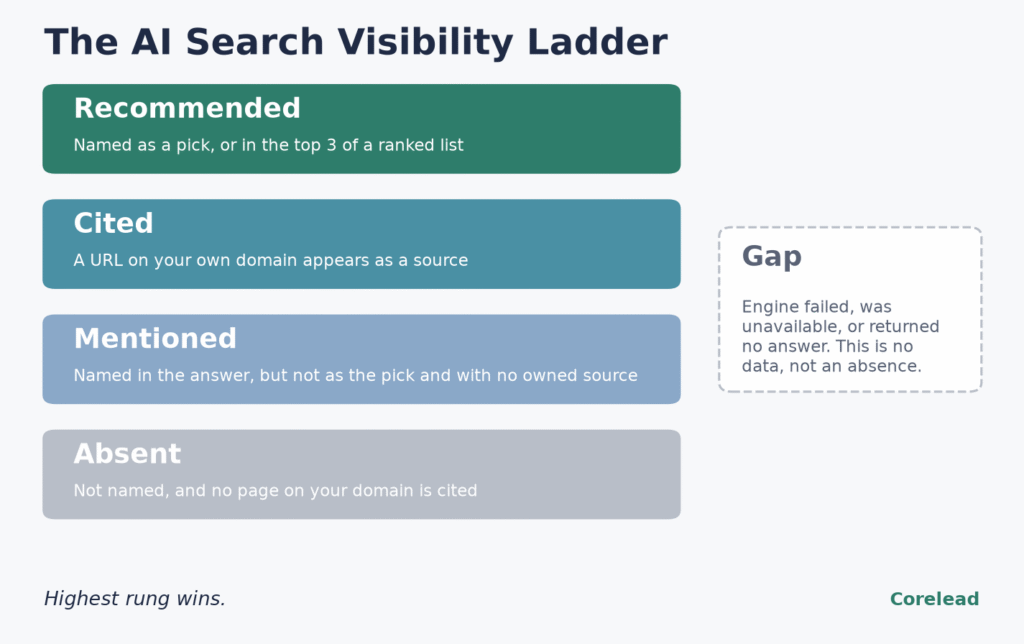
When we score an answer, we give the brand one label. If more than one label could apply, the highest rung wins: recommended, then cited, then mentioned, then absent. A gap sits outside the ladder. It means we could not read an answer, not that you finished last.
| Rung | What it means | What a typical answer looks like |
|---|---|---|
| Recommended | The engine names you as a pick, or places you in the top three of a ranked list. A neutral “tools like X, Y, and Z” list does not count. | “If you need a reliable option for this use case, my top recommendation is [Brand].” |
| Cited | A page on your own domain appears in the source list. A third-party article about you does not make you cited. | The write-up may not name you at all, while your guide or product page sits among the sources. |
| Mentioned | The answer names you (even in a comparison or a passing list) but does not recommend you and does not cite a URL you own. | “Shoppers also look at [Brand A], [Brand B], and [Brand C] for everyday use.” |
| Absent | The answer does not name you, and none of the sources belong to your domain. | The engine recommends other brands and cites review sites, retailers, or publishers you do not control. |
| Gap (not a rung) | The engine failed, was unavailable, returned no text, or did not show an AI Overview. | There is nothing to score. Record the reason and try again next week. |
We use the same rules in client reporting, so a name-drop is not counted as a recommendation.
Recommended
Recommended means the model is telling the reader to start with you, or putting you in the first few names of a ranked shortlist. A loose group of names with no pick and no order is only a mention. The source is not always your homepage. In our tracking, a SaaS tool we watch has been recommended with a third-party listing as the cited source, not only with pages on its own site. An engine may recommend you from a profile, directory, or editorial roundup it already trusts, which helps when that listing is accurate and hurts when it is thin.
Cited
Cited means the engine used a URL you control. This is easy to miss if you only search the answer for your brand name. We regularly see cited answers with no quotable sentence about the company, because the model used a how-to or category page for facts and then wrote a generic explanation. That still counts: a reader who opens the sources can reach you. If an answer names you and points to a review site or publisher, you were mentioned and that other domain was cited. A cited page of your own is something you can rewrite. A third-party citation is something you claim, correct, or earn.
Mentioned
Mentioned is the rung teams most often misread. Being named feels like visibility, even when the answer prefers someone else or never sends the reader to you. An apparel brand we track appeared in a casual-fitness answer as a mention, with a fashion magazine as the source rather than the brand’s own product page. Treat mentions as proof that the engine knows the name, not as proof that it will send demand your way.
Absent
Absent means we got an answer and you were not in it: no name, and no URL on your domain. That is not always a content emergency. Some questions are owned, for now, by national retailers, review sites, or educational publishers. A specialty retailer we track has gone through weeks with no recommendations on the buyer questions we watch, even while its pages appear in Google for related searches. Do not treat “absent” and “we could not check” as the same fact.
A gap is missing data, not a loss
Google does not attach an AI Overview to every query. An engine can time out. A provider can be unavailable for a day or a week. If you mark those rows as absent, your report will say you disappeared from places that never produced an answer. We keep the reason next to the gap: no AI Overview, empty response, failed request, or unavailable.
The week of November 9, 2026 makes the point clearly. That week we scored five brands we track on 100 buyer questions across ChatGPT, Gemini, Perplexity, and Google AI Overview. That is 400 brand-and-question readings in our dashboard.
The brands were recommended 8 times and cited as a source 11 times. They were mentioned, without a recommendation or an owned citation, twice. They were absent 226 times. The remaining 153 readings were gaps.
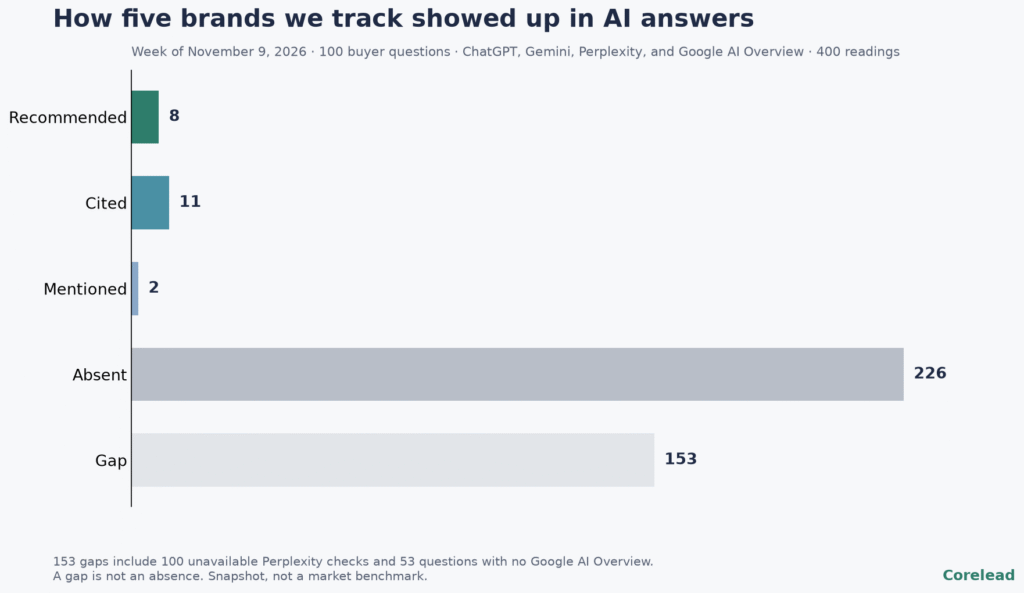
Those gaps were not evenly spread. All 100 Perplexity checks were unavailable, so we had no Perplexity answers to score. Google AI Overview appeared on 47 of the 100 questions and did not appear on 53. ChatGPT and Gemini both returned answers for every question in that set.
If we had filed the 153 gaps as absences, the week would have looked much worse than it was. A gap is a hole in the data, not a decline. A single screenshot of ChatGPT is not a measurement system either. One engine, on one afternoon, cannot tell you whether Gemini would have cited you, whether an AI Overview exists for that query, or whether Perplexity was down.
A Google ranking is not an AI citation
Because Google and answer engines start from overlapping web documents, it is reasonable to assume that a page-one ranking will carry over into citations. In practice, it often does not.
A how-to page we track sat around Google position 7 for the exact question we asked the engines. Indexing was not the problem. The page was findable. The AI answers still did not cite it. They preferred familiar reference sites instead.
That pattern is not a one-off anecdote. In the same week of November 9, 2026, the brands we track had their own domain on page 1 of Google for 10 of those buyer questions. On ChatGPT, 8 of those 10 answers still left the brand absent. Gemini did the same on 8 of 10. Only one of the 10 was a ChatGPT recommendation. Two questions produced an owned citation in Google AI Overview. Perplexity was unavailable, so we did not pretend to know how it would have treated those URLs.
A page that ranks and still is not cited is usually a content-shape or source-trust problem, not an indexing problem. The engine may want a tighter opening sentence or a table it can lift, or it may already trust a publisher, directory, or retailer more than your domain. You do not fix that by asking the team to “get us ranking higher” and then stopping. Google remains essential, which is why we store organic results beside the AI rungs. The pairing stops two mistakes: rewriting a page that already ranks when the real gap is how it is written, and ignoring a ranking page because the AI answer has not caught up yet.
How we score answers in practice
We start with a fixed set of buyer questions, grouped as category, problem, and comparison prompts. Branded questions (“what is [our company]?”) are useful, but they measure a different thing. Someone who already knows your name is not the same reader as someone who asked what to buy.
Each week we run those questions through ChatGPT, Gemini, Perplexity, and Google AI Overview, and we store the Google results beside them. For every brand-and-engine pair we keep the highest rung, the quoted sentence when one exists, the source URLs, and the gap reason when there is no answer. Rewording without a rung change is not a win or a loss. The rung is what we compare from last week to this week.
We do that inside our own AI visibility dashboard, rather than by pasting questions into chat windows. That is what lets us say, with a date on it, that Perplexity was a gap rather than a sweep of absences, or that a page-one URL still produced no citation.
A few rules keep the report honest. Compare only questions you asked in both weeks. Date every snapshot: the figures above describe the week of November 9, 2026, for five brands we track, not every company in every category. Do not invent a rival. Do not promise that a new page will be cited by a certain date; we record a baseline when a page goes live and wait two to four weeks before we judge it. Never treat an engine outage as a decline. The point is to decide what to do next: write one stronger guide instead of ten thin posts, refresh a page the engines already know, or claim a profile they already cite.
What to do once you know your rung
If you are recommended, protect the pages and listings the engines are using, and keep facts current. If you are cited, look at the exact URL. When the engine quotes a thin category page while your best guide sits elsewhere, make the better page easier to lift: a direct answer in the first lines, clear headings, and a table where a comparison belongs. If you are mentioned, read the sentence and the sources. You may need a fuller page of your own, or a presence on a site the model already trusts. If you are absent, resist publishing one article per tracked question. One durable guide that covers a related cluster is easier to cite than a set of near-duplicate posts. If you have a gap, wait for data, then re-run the question when the engine is responding.
None of that guarantees a mention, a citation, or a recommendation. AI answers change. The value is in knowing which rung you are on, this week, and why.
Work with Corelead on a done-for-you AI visibility audit
Corelead is a Chennai digital marketing agency. I founded it in 2010 after working in digital marketing and e-commerce since 1995. We help brands get found in search and in AI answers, and we built the weekly tracking and the AI visibility dashboard described here so we are not guessing from a single chat window.
If you want a clear picture of how ChatGPT, Gemini, Perplexity, and Google AI Overview currently talk about your brand, we can run a done-for-you AI visibility audit. We will score a set of buyer questions on the four rungs, set those results next to your Google rankings, and tell you which pages, listings, or guides are most likely to change the next reading. There is no ranking promise and no mention guarantee. You get a dated snapshot and a specific next step.
Start that conversation on our contact page. If you want the longer view of how we approach this work, see our AI search visibility overview.
